







The Master’s Manual to BeamNG.drive: Engineering, Physics, and High-Tier Driving
BeamNG.drive is far more than a "crashing simulator." It is a sophisticated soft-body physics engine that calculates real-time stress, torque, and deformation across thousands of individual nodes and beams. To truly master this game, a player must transition from a casual driver into a vehicle engineer and a physicist. Success in BeamNG isn't just about crossing a finish line; it’s about understanding the limit of a material's structural integrity, the thermodynamic constraints of an engine under load, and the delicate balance of a suspension system tuned for specific terrain. This guide is a deep-tier technical dive into the mechanics of the game, providing the high-level strategies needed to dominate everything from high-speed time trials to grueling rock-crawling expeditions.
The depth of BeamNG.drive lies in its lack of "hand-holding." There are no invisible barriers or simplified driving assists. If you downshift too early, your transmission will shatter; if you hit a curb at the wrong angle, your tie rod will bend, pulling your alignment to the left for the rest of the race. In the following chapters, we will explore the progression of mastery, moving from the initial configuration of your hardware to the complex tuning of differentials and forced induction systems, ensuring you have the technical edge required to master the horizon of this simulation.
1. Calibrating the Connection: Force Feedback and Input Precision
The first step to high-tier driving in BeamNG is the calibration of your input device. Unlike arcade racers, BeamNG relies on "Direct Input" physics. If you are using a steering wheel, you must understand the "Signal Clipping" threshold. When your Force Feedback (FFB) is set too high, the motor in your wheel cannot communicate the subtle vibrations of a losing grip because it is saturated by the primary steering forces. You should use the in-game "FFB Graph" UI app to ensure your peaks never hit the red ceiling, allowing you to feel the exact moment the front tires transition from static to kinetic friction.
For controller users, the "Steering Gamma" and "Filter" settings are the difference between smooth racing and erratic twitching. Because BeamNG simulates the physical rack and pinion of a car, a thumbstick needs a non-linear curve to mimic the precision of a steering wheel. By increasing the Gamma to roughly 2.2, you gain granular control over small adjustments at high speeds while maintaining the ability to throw the wheel to full lock during a drift. This calibration is the foundation upon which all other driving skills are built.
Optimal Input Configuration
- Force Feedback Smoothing: Set this to the lowest value your hardware can handle without "rattling." Lower smoothing provides more raw data.
- Deadzone Management: Ensure a 0% deadzone for steering to maintain a 1:1 ratio with the physics engine.
- Linearity Settings: Keep throttle and brake linearity at 1.0 to ensure your muscle memory develops around the actual pedal travel.
2. The Thermodynamics of Speed: Engine Cooling and Load Management
In BeamNG, engines are not just sound files; they are thermodynamic systems. High-performance builds often suffer from "Thermal Overload" long before they reach their top speed. When you increase the boost pressure on a turbocharger, you are not just adding horsepower—you are adding heat. To sustain high speeds on maps like the Automation Test Track, you must balance your "Radiator Effectiveness" against "Aerodynamic Drag." A larger radiator keeps the engine cool but creates a "parachute" effect that slows your top-end velocity.
Understanding the "Oil vs. Water" temperature delta is critical for endurance racing. Water temperature reacts quickly to throttle input, while oil temperature is a slower-moving metric that represents the internal health of the crankcase. If your oil exceeds 130°C, the viscosity breaks down, leading to a "Rod Bearings Melted" failure. To prevent this, master the art of "Lift-and-Coast" into corners, using the airflow to drop temperatures without losing significant lap time.
3. Suspension Geometry: Tuning for Contact Patch Consistency
Suspension in BeamNG is calculated through spring rates and damper valving. A common mistake is making a car too stiff. While a stiff suspension feels responsive, it causes the tires to "skip" over micro-bumps in the road, breaking the contact patch. To optimize grip, you must tune your Camber and Toe settings. Negative camber ensures that when the car leans into a corner, the outside tire flattens against the pavement, maximizing the surface area available for friction.
Suspension Tuning Priority
- Bump Stiffness: Controls how the car reacts to hitting a bump.
- Rebound Stiffness: Controls how quickly the wheel returns to the ground. Too much rebound will "pack" the suspension down, eventually bottoming it out.
- Anti-Roll Bar (ARB) Thickness: Essential for controlling body roll. Stiffening the rear ARB will increase oversteer, while stiffening the front will promote understeer.
4. Drivetrain Logic: Differentials and Torque Vectoring
The drivetrain is the most complex sub-system in the game. Choosing between an Open, Limited Slip (LSD), or Locked differential changes the car's fundamental DNA. An open differential is useless for performance as it sends power to the wheel with the least resistance. For track racing, a "Torque-Sensing" LSD is the gold standard, as it intelligently shifts power to the outside wheel during a turn, effectively "pushing" the car through the apex.
In off-road scenarios, such as the trails on Jungle Rock Island, you must master "Diff-Lock" management. Locking your differentials ensures all wheels spin at the same speed, which is necessary for climbing rocks but will snap an axle if used on high-grip pavement. High-tier players use the "Powertrain Visualization" UI app to monitor torque spikes, allowing them to disengage lockers the moment they transition from mud to solid rock, preserving the integrity of their half-shafts.
5. Aerodynamics and Downforce: Managing the Invisible Hand
At speeds exceeding 150 mph, BeamNG’s physics engine shifts its focus to aerodynamics. The game simulates "Lift" and "Downforce" on every body panel. If you remove a hood or a bumper, the drag coefficient changes, often making the car unstable at high speeds. To stabilize a high-power build, you must utilize "Splitters" and "Spoilers." A front splitter increases the "High Pressure" zone above the nose, pinning the front tires down and eliminating high-speed understeer.
Aero-Adjustment Checklist
- Wing Angle: Increasing the angle adds downforce but significantly increases drag.
- Ride Height: Lowering the car creates a "Vacuum" effect under the chassis (Venturi effect), but if the car is too low, the airflow "chokes," causing a sudden loss of grip.
- Brake Cooling Ducts: Necessary for heavy cars, though they slightly increase front-end drag.
6. The Art of Soft-Body Recovery: On-the-Fly Repairs
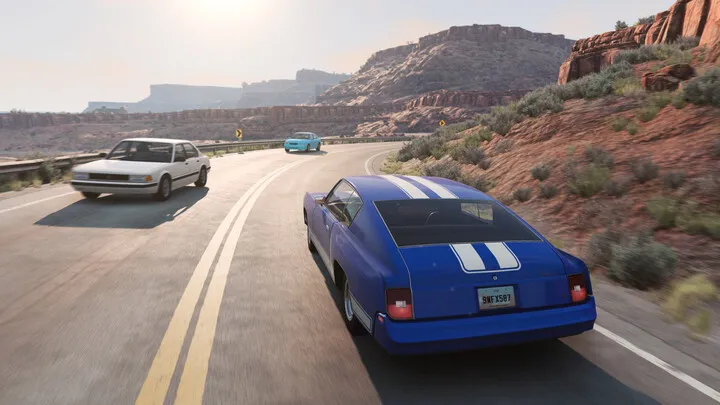
Because every part of the car is destructible, you will inevitably suffer minor damage that doesn't "kill" the car but makes it undrivable. Mastering the Radial Menu for individual part resetting is an advanced skill. If you pop a tire during a long-distance delivery, you don't need to reset the whole car; you can "Repair" just the wheels. Furthermore, understanding "Node Grabbing" allows you to pull a bent fender off a rubbing tire, enabling you to limp a damaged vehicle back to the pits.
In "Career Mode" or "Hardcore" scenarios, you must understand the cost of deformation. A bent frame cannot be perfectly fixed by a simple roadside repair; it introduces permanent "Crab-walking" where the car’s rear wheels do not track with the front. Learning to drive around a "bent" car—compensating with counter-steering—is the hallmark of a veteran driver who can finish a mission despite catastrophic mechanical failure.
7. Advanced Rock Crawling: Low-Range and Tire Pressure
Rock crawling in BeamNG is a game of millimeters. The "Tire Pressure" setting is your most powerful tool. Lowering your PSI to 5 or 10 allows the tire to "wrap" around rocks, increasing the mechanical keying between the rubber and the surface. However, low pressure increases the risk of a "De-bead," where the tire pops off the rim. Using Beadlock Wheels is mandatory for high-tier off-roading to prevent this failure.
Low-Range Techniques
- Transfer Case Management: Always shift into "4-Low" before a steep incline to multiply your torque and gain granular throttle control.
- Crawl Ratio Calculation: The combination of your transmission’s first gear and your differential ratio determines your "Crawl Ratio." A higher ratio allows you to descend steep hills using "Engine Braking" without ever touching the actual brakes, preventing a slide.
8. Forced Induction: Turbo Spool and Supercharger Curves
Power delivery in BeamNG isn't linear. Turbos require "Spool Time," meaning there is a delay (Turbo Lag) between pressing the gas and receiving power. To drive a high-boost car effectively, you must utilize "Left-Foot Braking" to keep the engine RPMs high and the turbo spinning while slowing down for a corner. This ensures that the moment you exit the turn, you have full boost pressure available.
Superchargers, on the other hand, provide "Instant Torque" but "Parasitic Loss." They take power from the crankshaft to generate air pressure. In heavy vehicles or drag cars, a supercharger is often better for "Launching" off the line, but it will eventually fall off in efficiency at high RPMs compared to a large turbocharger. Mastering the "Wastegate" pressure setting allows you to fine-tune the "Power Band" to match the gear ratios of your transmission.
9. Braking Systems: Fade, Bias, and Pressure
Brakes in BeamNG convert kinetic energy into heat. If you ride the brakes down a mountain pass in Italy, you will experience "Brake Fade." The pads will glaze, the fluid will boil, and your stopping distance will quadruple. To avoid this, you must master "Brake Bias." Shifting the bias toward the front (65-70%) provides stability, but shifting it toward the rear (55-60%) allows you to "Rotate" the car into corners using the brakes, a technique essential for rally driving.
Brake Components Hierarchy
- Premium Organic Pads: Best for daily driving; no warm-up required but fade quickly.
- Semi-Metallic Pads: The standard for racing; require some heat to work effectively.
- Full Carbon-Ceramic: Infinite fade resistance but nearly useless when cold. These should only be used on dedicated track builds.
10. Heavy Hauling: Weight Distribution and Trailer Physics
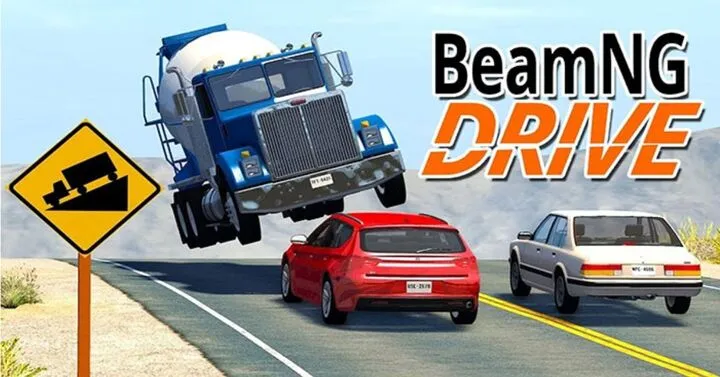
Driving a semi-truck or a heavy hauler in BeamNG introduces "Load Shifting" physics. Your center of mass is no longer static. If you take a turn too quickly with a liquid-filled tanker, the "Slosh" effect will carry the momentum of the water to the outside of the turn, flipping the truck. You must drive with "Anticipation," braking 300% earlier than you would in a passenger car.
When towing a trailer, you must account for "Jackknifing." This occurs when the trailer's momentum exceeds the truck's traction, pushing the rear of the truck sideways. To recover from a jackknife, you should never slam on the brakes; instead, you should apply "Counter-Steer" and increase throttle slightly to pull the trailer back into alignment. Mastering the "Independent Trailer Brake" control is the final step in becoming a master of the heavy-duty logistics side of BeamNG.
Conclusion
BeamNG.drive is a journey of mechanical discovery. It is a game that rewards the curious and punishes the reckless. By mastering the intricate details of suspension geometry, drivetrain logic, thermal management, and soft-body recovery, you move beyond being a mere "gamer" and become a virtual test driver. Every crash is not a failure, but a data point—a lesson in the structural limits of steel and glass. Whether you are building a 2000-hp dragster or a slow-speed mountain trekker, the key to success is a deep respect for the physics engine. Keep your tires pressurized, your radiator clear, and your steering smooth. The horizon of BeamNG is infinite, limited only by your understanding of the machine beneath you.